EMBAR SB: A secure boot manager that establishes trust before your first line of code runs
safecubed releases EMBAR SecureBoot – a two-stage signature architecture with an integrity-protected audit log and built-in key exchange
Overview
We are thrilled to announce the first release of our security solution EMBAR SecureBoot (SB). EMBAR SB is designed as a companion for existing bootloaders and applications to allow the fulfilment of central security requirements with minimal software changes.
What sets EMBAR SB apart from other solutions is its two-stage signature architecture providing an integrity-protected audit log on top of firmware verification, and its lightweight built-in key exchange.
EMBAR SB is available now for evaluation. As an optional add-on, EMBAR HSM extends EMBAR SB with a hardware root of trust for even stronger protection.
We support customers with the integration of EMBAR SB, or take over the complete integration on request. Get in touch now.
Why EMBAR SB?
Secure software update without bootloader interaction
In many ECU projects, security logic is spread across the normal bootloader – if it was considered at all. Every bootloader change then puts the whole trust chain at risk again. EMBAR SB removes that dependency. It runs as the first stage after reset and owns every security-relevant decision before any other code executes. The normal bootloader can then focus on communication and diagnostics.
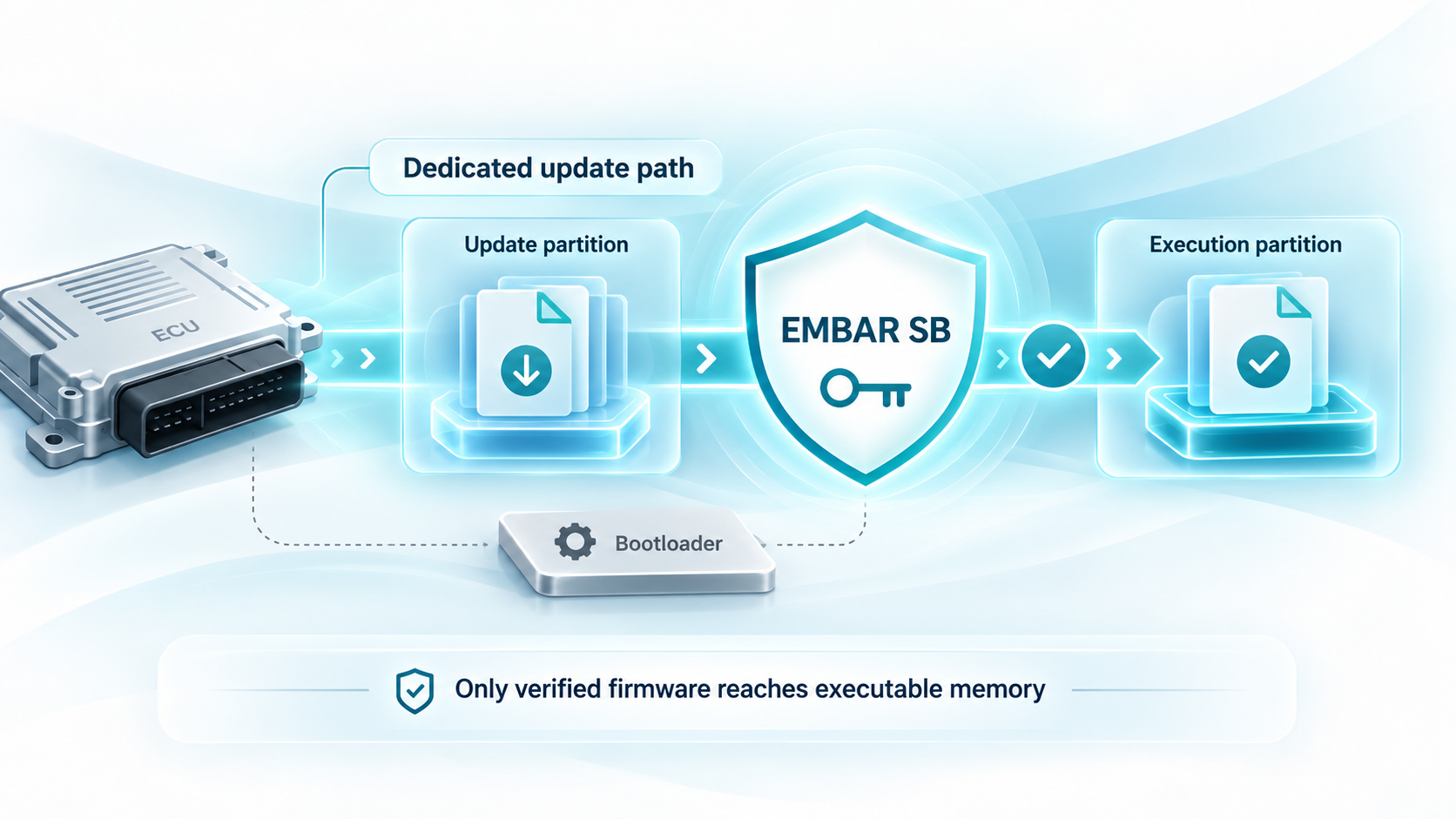
EMBAR realises this by employing a two-partition update model. A new software image is first written to a dedicated update partition. The SecureBoot Manager validates its signature and integrity. Only if an image passes verification, it is copied to the execution partition. Therefore, unverified or tampered images never reach executable memory. In the latter case, the device keeps running its last correctly verified software.
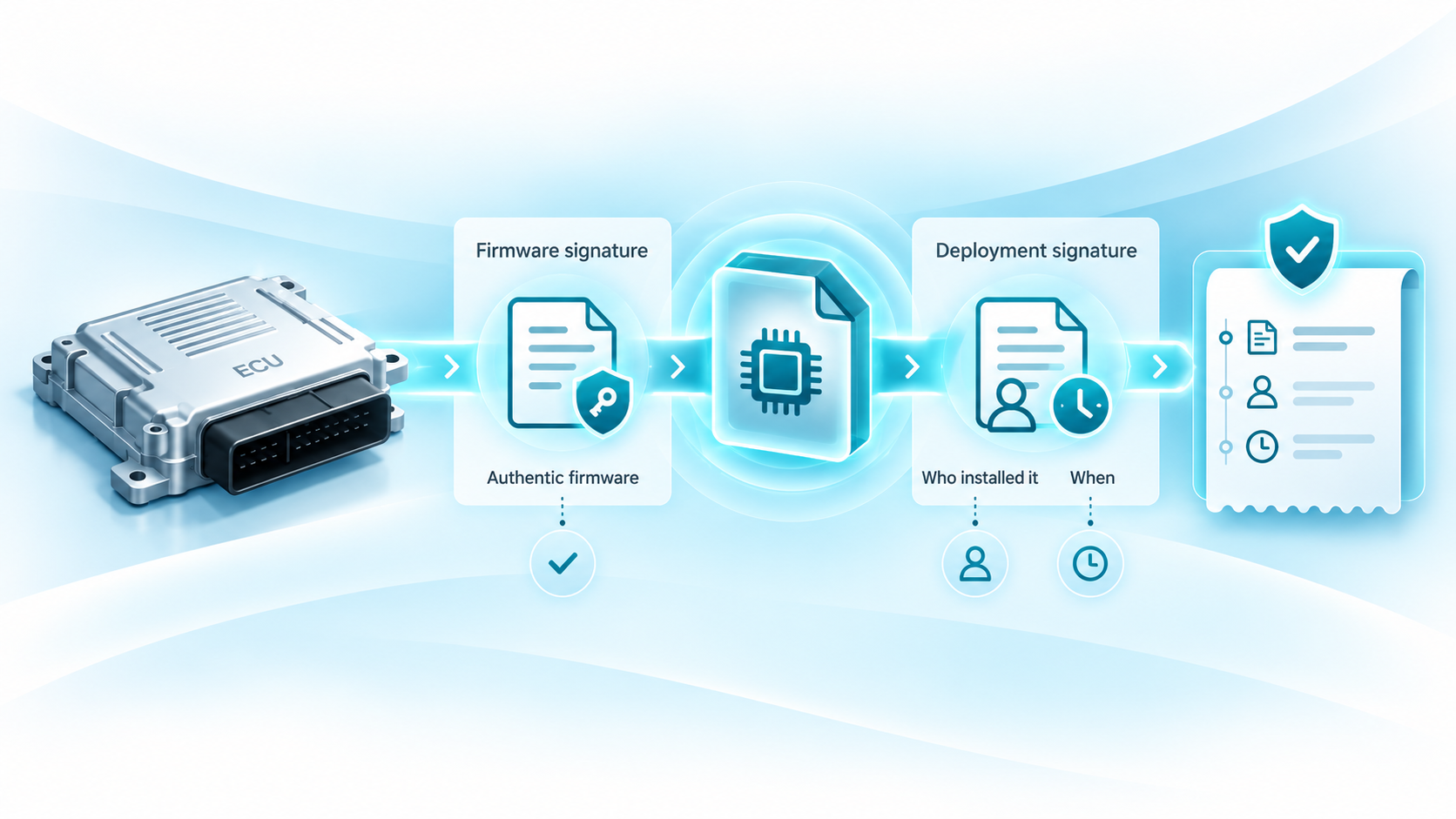
Two-stage signature: knowing what was installed, who installed it, and when
Conventional secure boot answers one question: is this firmware genuine? EMBAR SB answers a second one: how did it get onto this device?
- Stage one, the firmware signature. The software supplier signs the firmware image. This proves the code is authentic and unchanged, as in any secure boot solution.
- Stage two, the deployment signature. A second signature binds additional information to that image at installation time, for example who flashed it and when. The firmware stays untouched. The new information is attached and protected on top of it.
This gives OEMs, suppliers and service partners a tamper-proof record of every software installation. That record supports traceability, audits and incident investigation, and it fits the requirements of regulations such as IEC 62443.
Built-in key exchange: keys that can change without changing the device
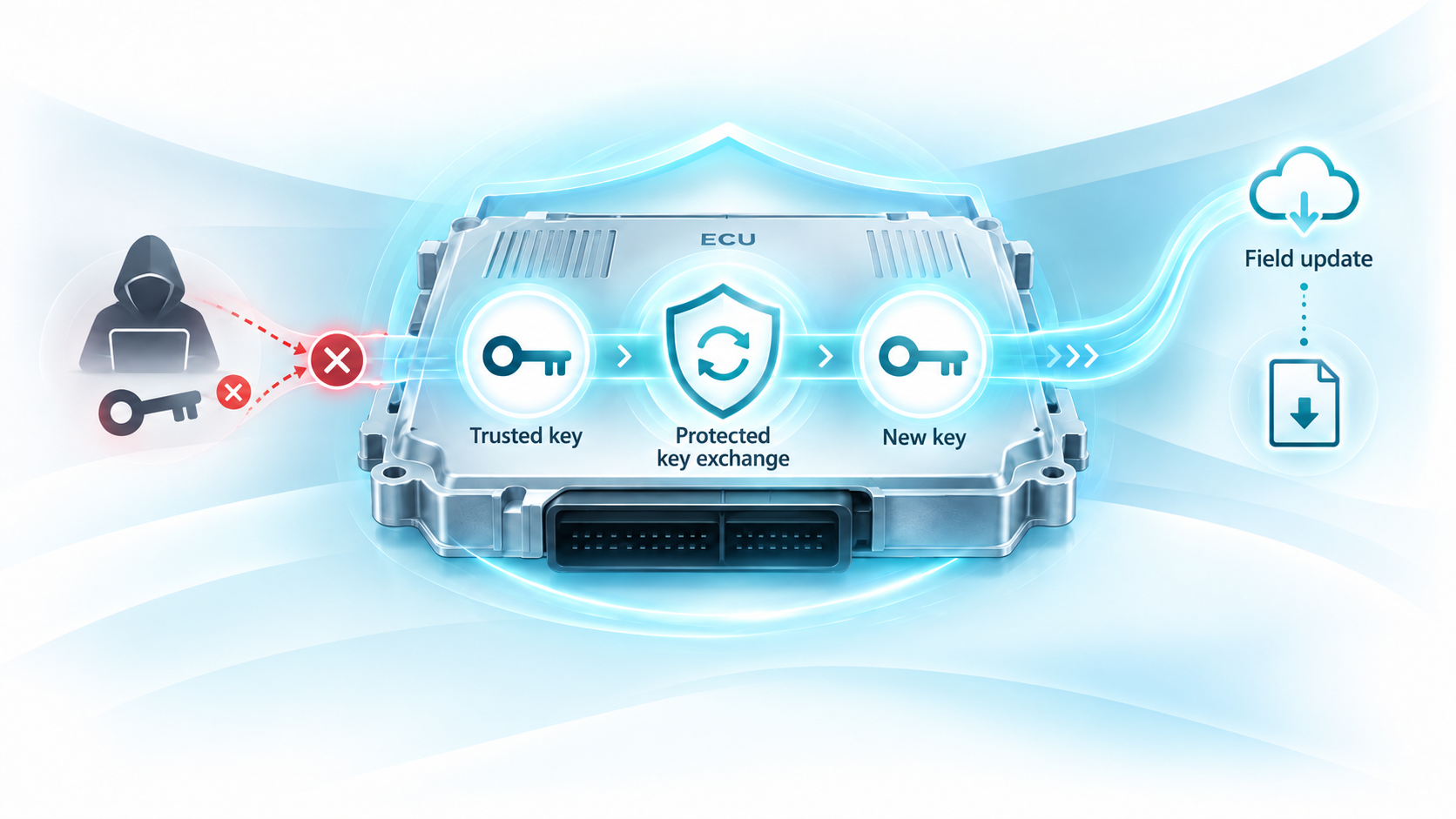
Cryptographic keys don't last forever. A key may be compromised, a supplier relationship may end, or a security policy may require regular rotation. In many systems, replacing a verification key means returning the ECU to the factory or reprogramming it with special equipment.
EMBAR SB has a secure key exchange built in. New keys can be installed in the field through the same protected update path, and only with authorization from the currently trusted key. The chain of trust is never broken, and attackers cannot install keys of their own. As a result, devices can stay secure for their entire lifetime, not only until the first key has to change.
HSM integration
EMBAR SB is designed to work with hardware security modules (HSMs). It can use an HSM for cryptographic operations and secure key storage, so the root of trust stays anchored in dedicated hardware. safecubed has also developed its own HSM solution for the Infineon AURIX™ TriCore™ platform, EMBAR HSM, which is built to complement EMBAR SB. Further details on EMBAR HSM will be announced soon.
Availability
EMBAR SB is available now for evaluation. safecubed offers integration support, from configuration and timing analysis to customer-specific adaptation, as part of its consulting and development services.
About safecubed
safecubed delivers safety and cybersecurity services for embedded systems, from consulting to software development. Its work covers secure boot, hardware security modules, cryptographic libraries and automotive ECU development.
Funding
EMBAR SB was developed with the support of the Wirtschaftsagentur Wien as a part of the project SEDRIC.
Request an EMBAR SB evaluation →
For further information, please contact:
Nico Ondracek, CEO
nico.ondracek@safecubed.com
From Structured Text to Verified C Code
Streamlining safety-relevant industrial software development with Embedded Coder and EverTest
Summary
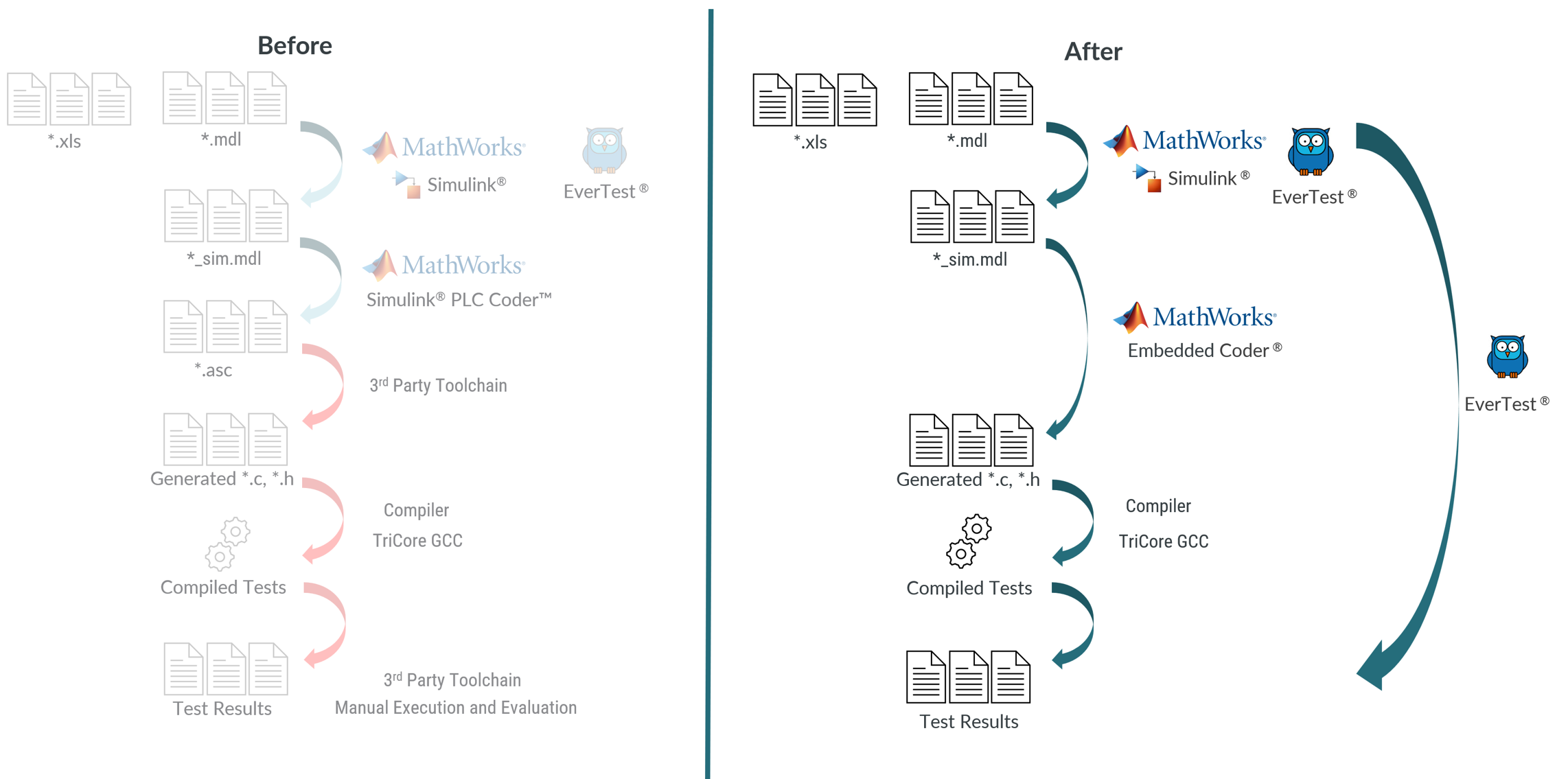
In safety-relevant industrial development, C code may be generated through multiple toolchain steps: Structured Text (ST) is generated from a model-based design, then converted into C code by a separate toolchain.
This workflow can split verification across different environments and make it harder to demonstrate that the code tested is representative of the final production implementation.
safecubed worked with EverBits to transition a real-world industrial customer application targeting an Infineon AURIX™ platform from an ST-based workflow to direct C code generation with MATLAB® Embedded Coder® and verification using EverTest®. The resulting workflow supports reuse of existing test cases across Model-in-the-Loop (MIL), Software-in-the-Loop (SIL), and Processor-in-the-Loop (PIL) verification, helping teams reduce duplicated effort and strengthen verification evidence for functional-safety development.
The Challenge
Some industrial teams use Simulink® PLC Coder™ to generate Structured Text as intermediate result and then rely on a second toolchain to generate the C code that runs on the target platform. This creates a fragmented verification workflow: model-level tests may run in MATLAB and Simulink, while later verification activities depend on a separate environment and toolchain.
Additional automation may be needed to connect the model-based test environment with the PLC toolchain. Depending on the workflow, the code executed during PIL testing may also include a generated test harness or integration code and therefore differ from the final production implementation. This can complicate the task of demonstrating equivalence between the tested code and the software intended for deployment. Limited support for automated parameter variation can further constrain systematic testing.
The Solution
safecubed and EverBits demonstrated a streamlined workflow that generates C code directly from the model using Embedded Coder and uses EverTest to support test-driven development and verification. The transition of the customer application was completed in less than four weeks by retaining and extending the existing verification assets rather than rebuilding the test process.Reusing (MIL) test cases during the transition
Existing Model-in-the-Loop (MIL) test cases were reused to verify that model adaptations needed for Embedded Coder did not introduce unintended behaviour. Requirements-based test cases were also used to demonstrate full structural test coverage of the model.Combining SIL and PIL verification in one workflow
EverTest integrates the generated production C code into the Simulink test environment as a model variant. The same test bench can therefore be used to exercise both the model and the compiled C code in Software-in-the-Loop (SIL) testing, keeping verification within MATLAB and EverTest rather than requiring a separate SIL toolchain. The same verification workflow can be extended to Processor-in-the-Loop (PIL) testing on the target processor, adding evidence from execution in the target environment. Together, SIL and PIL complete the verification strategy in accordance with IEC 61508 and ISO 26262 and create a consistent test strategy.Automated parameter variation
Existing MIL test cases, including cases that vary parameter values, can also be applied during SIL and PIL testing. EverTest uses a generated C-code wrapper to make parameter changes from the MATLAB environment effective during SIL and PIL execution, supporting systematic verification of the generated C code.The Outcome
In less than four weeks, safecubed and EverBits transitioned the customer application to a direct C-code generation and verification workflow using Embedded Coder and EverTest. The workflow reuses existing test cases, keeps model and SIL testing in the MATLAB environment, supports automated parameter variation, and extends verification to PIL testing on the target processor. These capabilities can reduce duplicated testing effort and help teams build clearer verification evidence for projects developed with reference to IEC 61508 and ISO 26262.